
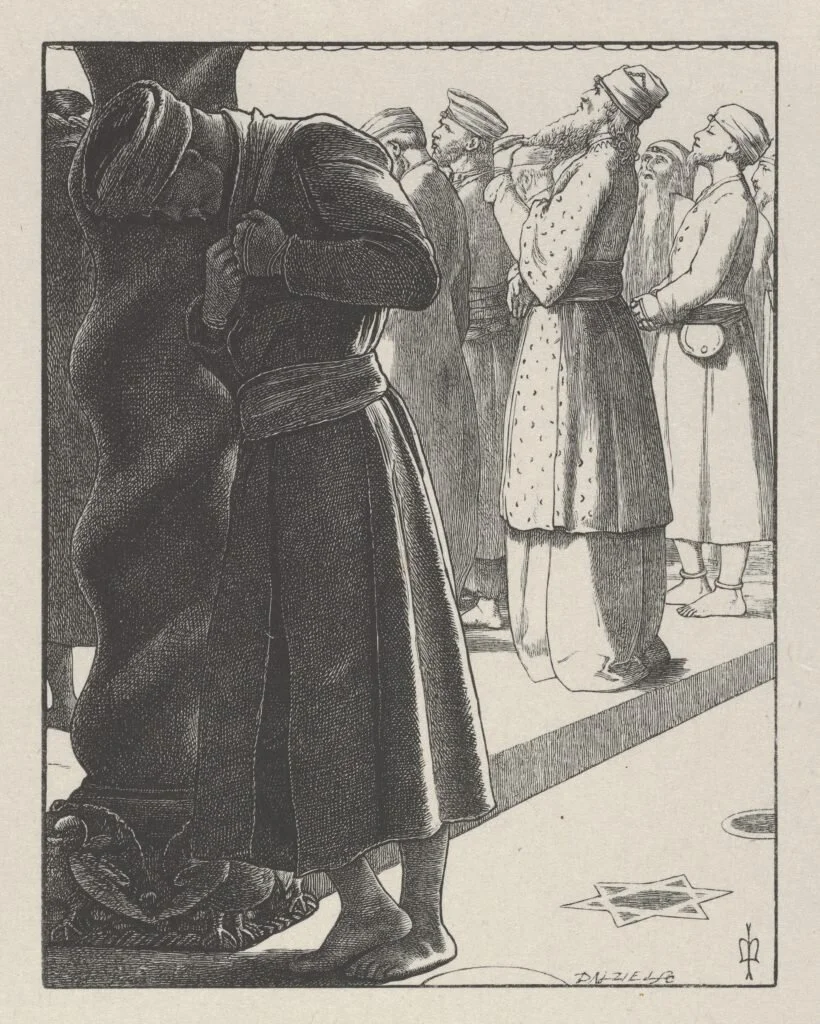
Image: The Pharisee and the Publican (The Parables of our Lord and Saviour Jesus Christ), Public Domain. Image Location: https://picryl.com/media/the-pharisee-and-the-publican-the-parables-of-our-lord-and-saviour-jesus-christ-3a4e36
To Save the Sheep, John 10.11-16

Jesus as our good shepherd is one who will lay down his life for the sheep. He is completely different from the hired hands who flee when the wolf comes. He defends his sheep and cares for them because they are his own. Father Jeremiah considers this truth in his sermon today.
Image: Shepherd with His Flock, by Francesco Londonio, CC0 1.0. Image located: https://commons.wikimedia.org/wiki/File:Francesco_Londonio%2C_Shepherd_with_his_Flock%2C_NGA_124653.jpg
The Christ Who Undoes, Luke 24.26-49

When Jesus appeared before his disciples throughout the forty days before his ascension, he reveals to them all what he has undone about the brokenness in this world. Father Jeremiah reflects upon these undoings of Jesus in his sermon today.
Image: The risen Jesus appears to the disciples in the upper room, from Sant'Apollinare Nuovo, Ravenna, photo taken by Nick Thompson, no changes made, licensed under CC BY-NC-SA 2.0. Image location: https://www.flickr.com/photos/pelegrino/4669927869
Peace of God Despite Doubt, John 20.19-31

Peace and doubt come together in our text from St. John 20.19-31 today. Our doubts can be overcome when we discover the peace that Jesus brings to us through his death and resurrection. Father Jeremiah draws our attention to this to this movement today in his sermon.
Image: Christ and St. Thomas by Andrea del Verrocchio, photo taken by Glenfarclas, CC BY-SA 3.0, no changes made. image location:https://en.wikipedia.org/wiki/File:Verrocchio_Christ_and_St._Thomas_closeup.JPG
Unexpected Resurrection, Mark 16.1-8

Jesus’ resurrection took the people by surprise despite his announcing it multiplies to his disciples. Why was this? What does it mean? How can we fully embrace what the resurrection does for us? Father Jeremiah helps us lay hold of the great truth of Jesus’ bodily resurrection and rejoice that Christ is risen.
Image: Saint Julie Billiart Catholic Church (Hamilton, Ohio) - stained glass, Resurrection of Christ, photo by Nheyob, CC BY-SA 4.0 <https://creativecommons.org/licenses/by-sa/4.0>, via Wikimedia Commons. No changes made
Good News for Good Friday, Isaiah 52.13-53.12

Empowered by an Uttermost Love, John 13.1-15

On the night that Jesus was betrayed, he took time to wash his disciples’ feet and through that to teach them that they are to love one another. He also later took bread and broke it and a cup of wine and gave it to them. This act is the first Eucharist. On Maundy Thursday we remember these actions by Jesus and what they mean for us today.
The King Who Overthrows, Mark 11.1-11

On Palm Sunday, we remember the coming of Jesus into Jerusalem to the accolades of the people. They shout, “Hosanna” to the Lord and acclaim him as king. This Jesus who has kept aspects of his identity hidden from the masses and avoided them whenever they attempted to hail him as king, now enters Jerusalem in the most public of ways. What does it mean? How does this coming touch on various Old Testament writings? How do we respond knowing in advance where this week is going to end up? Listen now to hear Father Jeremiah’s thoughts on all of this.
Image: Photo taken by Ted. Entry into Jerusalem, from St. George Orthodox Cathedral, Toledo, OH. Licensed under CC BY-SA 2.0, no changes made. Location: https://www.flickr.com/photos/frted/5713013694/in/photostream/
The Dying Grain of Salvation, John 12.20-36
A grain of wheat will not produce a harvest without dying first by falling into the ground. Jesus points out the reality of his coming death with this image in our Gospel text but connects it to the bronze serpent and being the true light. Father Jeremiah takes us through these images and the realities that affect us because of Jesus’ being that Dying Grain.
Image: The Harvest (1888) by Van Gogh. Photo taken by Gandalf’s Gallery. Licensed under CC BY-NC-SA 2.0. Image location: https://www.flickr.com/photos/gandalfsgallery/15516300017
All Hail the Bread King, John 6.1-15

How do we respond to Jesus’ multiplying the loaves and fishes? What was the meaning of it then? How do we understand it for today? There are many things are happening in St. John’s telling of this event and Father Jeremiah delves into some of them for us to consider in this sermon from St. John 6.1-15
Image: The Miracle of the Loaves and Fishes, Jacopo Tintoretto, CC0, via Wikimedia Commons. Image location: https://commons.wikimedia.org/wiki/File:The_Miracle_of_the_Loaves_and_Fishes_MET_DT5476.jpg
Eaten by Zeal, John 2.13-22

When Jesus cleansed the Temple, it wasn’t out of anger, but out of his zeal for the purity of God’s sanctuary. He was consumed and eaten up with this zeal, so much to that he would die as the true Temple and through his resurrection, build an expansive temple that includes all believers. And now, that same zeal for the old earthly Temple is still a part of Christ and he is purifying us as well in his zeal and giving us the same zeal for the Temple and Body of Christ.
Image: Christ Expelling the Money Lenders, from The Small Passion, Albrecht Dürer, CC0, via Wikimedia Commons
Unable to Help Myself, Mark 8.31-38

After hearing the confession of Peter regarding Jesus’ true identity, Jesus begins teaching them about what the Messiah must do. But Peter rejects this only to be rebuked by Jesus and confronted, alongside the disciples and others, with the reality that we are to take up our own crosses. How does this truth connect to our Collect of the Day that says that God knows that we have no power in ourselves to help ourselves? Father Jeremiah brings these together revealing the work of God in us.
The Flood, Baptism, and Temptation, Mark 1.9-13

In our readings for the First Sunday in Lent, we hear not only about Jesus’ temptation, but also about the promise of Yahweh after the flood and the work of baptism in us. How do all of these things come together for us? What can we apply about these passages to our lives today? Listen to find out what Father Jeremiah says.
Image: Jesus’ Temptation, St. Benedict’s Catholic Church, T Kean, CC BY-SA 3.0, <https://creativecommons.org/licenses/by-sa/3.0>, via Wikimedia Commons. Image location: https://commons.wikimedia.org/wiki/File:St_Benedicts_Catholic_Church_-_Inside_-_Temptation_of_Jesus.JPG
Tension and Grace, Ash Wednesday

On Ash Wednesday we hear from Scripture about sinful fasting and repentance that isn’t really fasting and repentance because it is done for the publicity and show of it. And yet, we are fasting and repenting publicly ourselves. What do we do with this tension that we find before us in Scripture and ourselves? Father Jeremiah considers this in his Ash Wednesday sermon.
Image: by Jerome Quinto, SDB. Licensed under CC BY-NC-ND 2.0. No changes made. Image location: https://www.flickr.com/photos/techunk_7/16566392255/in/album-72157648552783614/
A Tale of Two Mountains, 1 Kings 19.9-18, Mark 9.2-9

Elijah went up on a mountain to meet Yahweh, where he found the voice of God in a thin whisper. Peter, James, and John went up a mountain with Jesus and witnessed something beyond imagining. When all was done, though, what were they left with? Was it only the experience or something greater than any experience to be known this side of eternity?
Comfort, Authority, and Fame, Mark 1.21-28

Image: Public domain, via Wikimedia Commons Location: https://commons.wikimedia.org/wiki/File:JesusCuresamute.gif
The Kingdom and the Calling, Mark 1.14-20

Jesus’ preaches the kingdom and repentance and in this preaching calls his disciples. When Jesus calls Peter, Andrew, James, and John, it isn’t the first time they’ve met. They have all recognized him as the Messiah previously, but now, Jesus calls them out of their daily lives into ministry and discipleship apart from their everyday lives. Not all of us receive this kind of call into ministry, but we all receive the call into the kingdom just as his first disciples did. How do we respond? How do we react?
image: A print from the Phillip Medhurst Collection of Bible illustrations, Pieter van der Borcht (ca. 1540-1608), CC BY-SA 3.0, via Wikimedia Commons. Image location: https://commons.wikimedia.org/wiki/File:77_Life_of_Christ_Phillip_Medhurst_Collection_3543_Simon_Peter_%26_Andrew_with_Christ_Matthew_4.18-20_Mortier.jpg
Come and See Jesus, John 1.43-52

For many of us, finding Jesus is crucial to our understanding of our faith. But in our text from John 1, we are reminded that it all starts with God knowing and calling us to “Come and see” through his people. It is Jesus who finds us and brings us to himself as the one who unites heaven and earth.
Image: Biblical illustrations by Jim Padgett, courtesy of Sweet Publishing, Ft. Worth, TX, and Gospel Light, Ventura, CA. Copyright 1984. CC BY-SA 3.0. No changes made. Location: https://commons.wikimedia.org/wiki/File:Gospel_of_John_Chapter_1-10_(Bible_Illustrations_by_Sweet_Media).jpg
Jesus, Baptism, and the Holy Spirit and Water, Mark 1.7-11

When Jesus was baptized, many things happened! Father Jeremiah looks at this event and helps us to understand how all of it relates to our own baptisms.
The King is Here, Matthew 2.1-23

When the Magi came, all of Jerusalem as well as King Herod were stirred up. Herod chafed at the idea of a new king, the scribes and pharisees were indifferent about the birth of the Messiah, but the Magi continued to search until they found him that they might worship and adore. The King is here whether we want him to be or not and we are called to worship and adore him!
Image: Adoration of the Magi, tapestry, by Edward Burne-Jones, Public domain, via Wikimedia Commons. Image location: https://commons.wikimedia.org/wiki/File:Edward_Burne-Jones_-_The_Adoration_of_the_Magi_-_Google_Art_Project.jpg